

Today, most digital marketers understand that they need to test, iterate, and optimize their marketing campaigns. The problem with this is that marketers are now so good at optimizing campaigns, competition has intensified, driving customer acquisition costs higher. Growth marketing is a solution to this challenge.
Unlike traditional marketing, which focuses on generating demand, growth marketing identifies and removes constraints across the entire customer journey. Popularized by companies like Amazon, Airbnb, and Dropbox, it has become the growth model that underpins many of the world’s fastest-growing companies.
In this article, we will explore:
- What growth marketing actually is
- Growth marketing vs traditional marketing
- How to build a growth marketing system
- Top growth marketing strategies in 2026
By the end of this guide, you’ll have a practical framework for building AI-powered growth systems that continuously learn from customers and improve business results.
What is growth marketing?
Growth marketing is the process of using customer data, experimentation, and continuous improvement to drive growth across the entire customer lifecycle.
Consider the familiar lifecycle: Awareness, Acquisition, Activation, Retention, Revenue, and Referral. Traditional marketing assumes growth comes primarily by focusing on driving Awareness and Acquisition. However, growth marketing starts by asking “what is the biggest constraint to growth today?”
The answer might be awareness. But it might also be sales conversion, onboarding, customer retention, or referrals. The job of growth marketing is to measure the entire system, identify that constraint, and coordinate improvements until the constraint has been removed.
For example, if a company’s CAC payback period has stretched beyond 36 months, a growth team might experiment with pricing, packaging, onboarding, or expansion offers to recover customer acquisition costs more quickly.
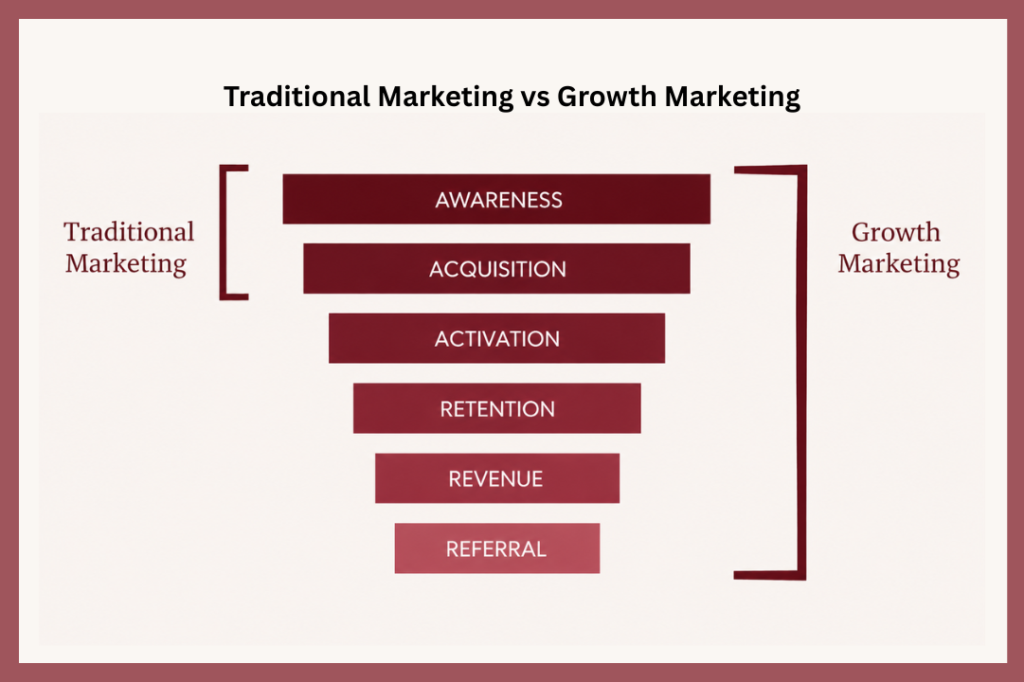
Note: Growth marketing has evolved beyond the traditional funnel to encompass the entire customer lifecycle. This is often visualized using the bow-tie model which treats retention, expansion, and advocacy as equally important drivers of growth.
Growth marketing vs traditional marketing
As we have just seen, both traditional marketing and growth marketing exist to help businesses grow. However, whilst traditional marketing is primarily responsible for creating awareness, generating demand, and getting qualified leads in front of sales, growth marketing takes a broader view.
In this section, we will explore how marketing has evolved from a purely top of funnel activity, and set the stage for how to create your own growth marketing system.
- Traditional Marketing: Driving Demand Through Campaigns
- Growth Marketing: Building a System of Continuous Improvement
- The Bow-Tie Model: Mapping the Customer Value Stream
- KPI Management: Finding and Removing Growth Constraints
Traditional Marketing: Driving Demand Through Campaigns
Traditionally, marketing has focused on creating demand and driving customers toward a purchase decision through channels such as advertising, content, email, sales enablement, and public relations. Marketing teams do this by understanding customer needs, identifying the most compelling benefits of a product, and positioning it within the market so that customers understand why it is the right choice compared to alternatives.
However, as performance and brand marketers became increasingly sophisticated, competition for customer attention intensified. As a result, reaching the right customers at an efficient cost has become more difficult.
In 2010, following his work helping scale Dropbox, Sean Ellis coined the term “growth hacking”—later popularized as “growth marketing.” Ellis believed that activation was the foundation of sustainable growth. He realized that if companies could consistently guide users to the point where they experienced the product’s core value, the companies could increase retention and reduce customer churn. In turn, this created a compounding effect: more customers stayed, customer lifetime value increased, and growth became more efficient.
Growth Marketing: Building a System of Continuous Improvement
At a high level, there are five steps to building an adaptable growth marketing system.
- Determine your “North Star” metric
- Assemble cross functional teams
- Map your sales & marketing funnel
- Implement the build, measure, learn loop
- Iterate on your North Star metric
Let’s dive into what each of these mean now.
1. Determine your North Star metric
Growth marketing begins by defining the One Metric That Matters (also called the North Star metric). This is the metric that most accurately captures the core value you create for your customers. To determine what this is, you need to look at your equation for growth. This is a simple formula that represents all of the key factors that will combine to drive your growth. The formula is different for every company.
For instance, at Dittofi, our growth equation was:
Qualified Leads × Sales Conversion Rate × Initial Project Revenue × Launch Rate × Customer Expansion Rate = Revenue Growth
The variables in this equation represented the key drivers of our growth:
- Qualified leads were generated through paid acquisition, content marketing, and lead magnets.
- Sales conversion rate depended on converting booked calls into customers.
- Initial project revenue came from selling our marketplace app development bootcamp.
- Launch rate was the percentage of customers who successfully got their marketplace live.
- Customer expansion rate represented the customers who continued after launching their product and moved into our ongoing subscription model.
In the case of Dittofi, our North Star metric was launch rate—the percentage of customers who successfully launched their marketplace. We therefore assembled a cross-functional team with a single objective: increase the launch rate.
2. Assemble a cross functional team
Traditionally, organizations were divided into functional departments. Marketing generated demand, sales closed deals, product defined requirements, engineering built the product, and customer success supported customers after the sale. While this encouraged specialization, it also created silos that slowed learning.
Agile and Lean evolved this model by bringing product managers, designers, and engineers into cross-functional teams. Growth marketing extends this idea further by including marketing, sales, and customer success—allowing teams to optimize the entire customer journey, not just the product.
The benefit of involving marketing in product decisions is that marketers have a deep understanding of customer needs, buying behaviour, and perceived value. These insights help teams design products, pricing, and messaging that better align with what customers actually want.
3. Map your sales & marketing funnel
***